
Setting: Canton (China) and Oxford (UK) in an alternate 1830s
First line: By the time Professor Richard Lovell found his way through Canton’s narrow alleys to the faded address in his diary, the boy was the only one in the house left alive.
Rebecca Kuang is one of those authors, like Margaret Atwood, who was simply born to write. Not yet thirty, Kuang has already written a trilogy and three novels, in various genres, while studying for doctorates at Cambridge and Oxford, and now Yale. You can only gaze on in awe – and cheer her on.
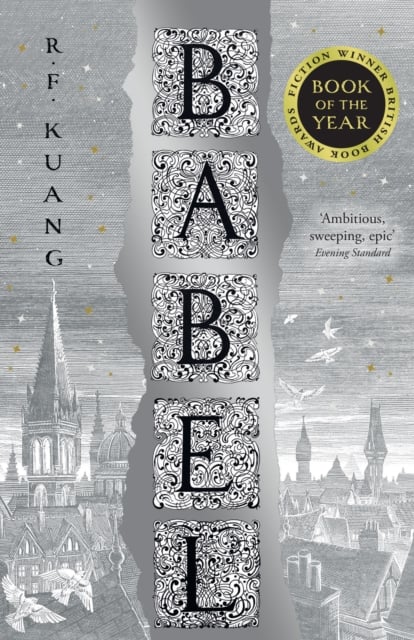
Babel is an extraordinary epic. Set in an alternate 1830s Oxford University dominated by Babel, the Royal Institute of Translation, the narrative operates on multiple levels. On the one hand, as the novel’s full title reveals, it is the (gripping) story of a revolution:
BABEL
OR
THE NECESSITY OF VIOLENCE
An Arcane History of the Oxford Translators’ Revolution
On another, it’s an exploration of how the violence of Empire is lodged deep within outwardly civilised, genteel institutions, masked by titles and traditions and the beauty of dreaming spires. And on yet another, it’s the story of a group of translation students who become close friends: Robin Swift, brought from Canton (Guangzhou) to England as a young boy by one of Babel’s professors; Ramiz Rafi Mirza (Ramy) from Calcutta; Victoire Desgraves from Haiti; and Letitia Price (Letty) from England. Between them, they speak Cantonese, Urdu, Arabic, Persian, Kreyòl, French, German, Latin and Greek.
Babel shows how the ability to speak certain languages, and to translate and communicate effectively, have always formed part of colonialism’s success. But Kuang adds an extra speculative feature to the mix: Babel translators have the ability to inscribe silver bars with language match-pairs, which in combination have powerful real-world effects. For example, a bar inscribed on opposite sides with the old French word ‘triacle’ (‘antidote’) and the English word ‘treacle’ (whose 17th-century usage relates to sugar disguising medicine’s bitter taste) has the power to cure illness (p. 159). Other silver-work match-pairs have less benign effects.
If you’re looking for an epic set in a fully realised alternate historical world — complete with maps and a schematic of the Babel tower — and that tackles big themes such as oppression, self-determination, betrayal, friendship, and resistance, then this one is for you. Babel is an extraordinary literary achievement and I can’t wait to read Kuang’s new novel, Katabasis, which is out this August.
R. F. Kuang, Babel or the Necessity of Violence, Harper Voyager 2022 (544 pp.)
 Bibliophile